Casiny Notes Australia
Casiny account login, verification and limits
 Available in US
Casiny uses email and password for account access, while identity checks can extend to personal documents, address records and payment ownership. Its one-account rule, responsible-gambling controls and withdrawal conditions make account access a broader issue than remembering a login. Each part of the account has a different purpose and a different financial consequence.

Table of Contents
- Deposit, loss and session controls serve different purposes
- Email access and device security affect the whole account
- One account and payment ownership form the main contractual boundary
- Identity reviews can involve documents and live checks
- Questions about Casiny accounts
- Identity and payment ownership are central to account access
Deposit, loss and session controls serve different purposes
Casiny’s Australian-facing materials describe deposit limits, loss limits and session limits, together with cooling-off and self-exclusion options. Those controls address different exposures. A deposit limit measures money paid into an account over a period; a loss limit concerns the amount lost; a session limit restricts time spent interacting with games. It is possible for spending, playing time and total stakes to move in different directions during the same session.
A balance can be recycled through several rounds after occasional wins. Consequently, total stakes may become much larger than the money originally deposited. A deposit ceiling helps define an amount of new money exposed, whereas a session limit addresses prolonged attention and repeated decisions. Neither changes the underlying chance of losing a particular wager. A loss limit helps focus on a different measure: the reduction of funds through play.
| Control | What it addresses | What it cannot decide |
|---|---|---|
| Deposit limit | New money transferred to the gambling account | How many times an existing balance may be staked |
| Loss limit | The amount of loss permitted within the selected control period | The outcome of a particular game round |
| Session limit | Time spent in a session | Whether an individual stake will win or lose |
| Cooling-off or self-exclusion | Access during a break or exclusion period | The recovery of money already lost |
The operator’s terms say deposit limits also apply to cryptocurrency deposits. For this hybrid cashier, the deposit-limit clause covers card and cryptocurrency funding alike. Cryptocurrency also introduces exchange-rate movement and the possibility of an irreversible transfer to a wrong wallet address. The resulting financial exposure is separate from the result of a game.
A break and a permanent boundary are different choices
A cooling-off period is a temporary interruption. Self-exclusion is intended as a stronger separation from gambling activity. Casiny’s information describes self-exclusion requests handled through customer support. A customer should not assume that closing a browser tab, logging out or deleting a home-screen shortcut performs the same account-level action; those steps only affect how the device displays the service.
Risk controls have value before a session escalates. Repeatedly changing a limit in response to losses, or treating a new deposit as a chance to recover prior spending, undermines the purpose of a financial boundary. The distinction between new deposits, net loss and total turnover also explains why one headline balance figure does not fully describe a gambling session.
- Money boundary: the amount a person is prepared to lose without affecting essential expenses.
- Time boundary: an independent stopping point that does not move after a win or loss.
- Access boundary: a break or exclusion arrangement that does not depend on willpower during a session.
- Outside assistance: Gambling Help Online provides confidential support independently of casino account controls.
For someone experiencing gambling-related distress, the Australian National Gambling Helpline at 1800 858 858 offers free, confidential assistance. Its purpose is support, not help with a casino transaction or the outcome of a disputed bet.
Email access and device security affect the whole account
Casiny describes a conventional email-and-password account sign-in. Its Australian information also describes password recovery and optional two-factor authentication. The second factor, when enabled, creates another security step beyond possession of a password. It can reduce the usefulness of a stolen password, but it does not eliminate the risks of social engineering, compromised email access or an unattended unlocked device.
The email account linked to a gambling profile is particularly sensitive because it may receive password-reset messages, account notices and correspondence about identity checks. Someone with access to that mailbox may be able to start a password reset even without knowing an existing password. Security therefore extends beyond the visible login form to the mailbox and devices on which it is opened.
- Recognise the account identifier. Casiny uses email credentials, so the security of that inbox and the gambling profile are linked.
- Distinguish a login factor from recovery. Two-factor protection and password recovery address different events; recovery of a compromised mailbox can remain a weak point.
- Separate shared-device convenience from privacy. Saved passwords, autofill and retained sessions may expose account details to another person using the device.
- Keep account correspondence coherent. Statements about identity, payment ownership and contact details can matter when the same account later faces a withdrawal review.
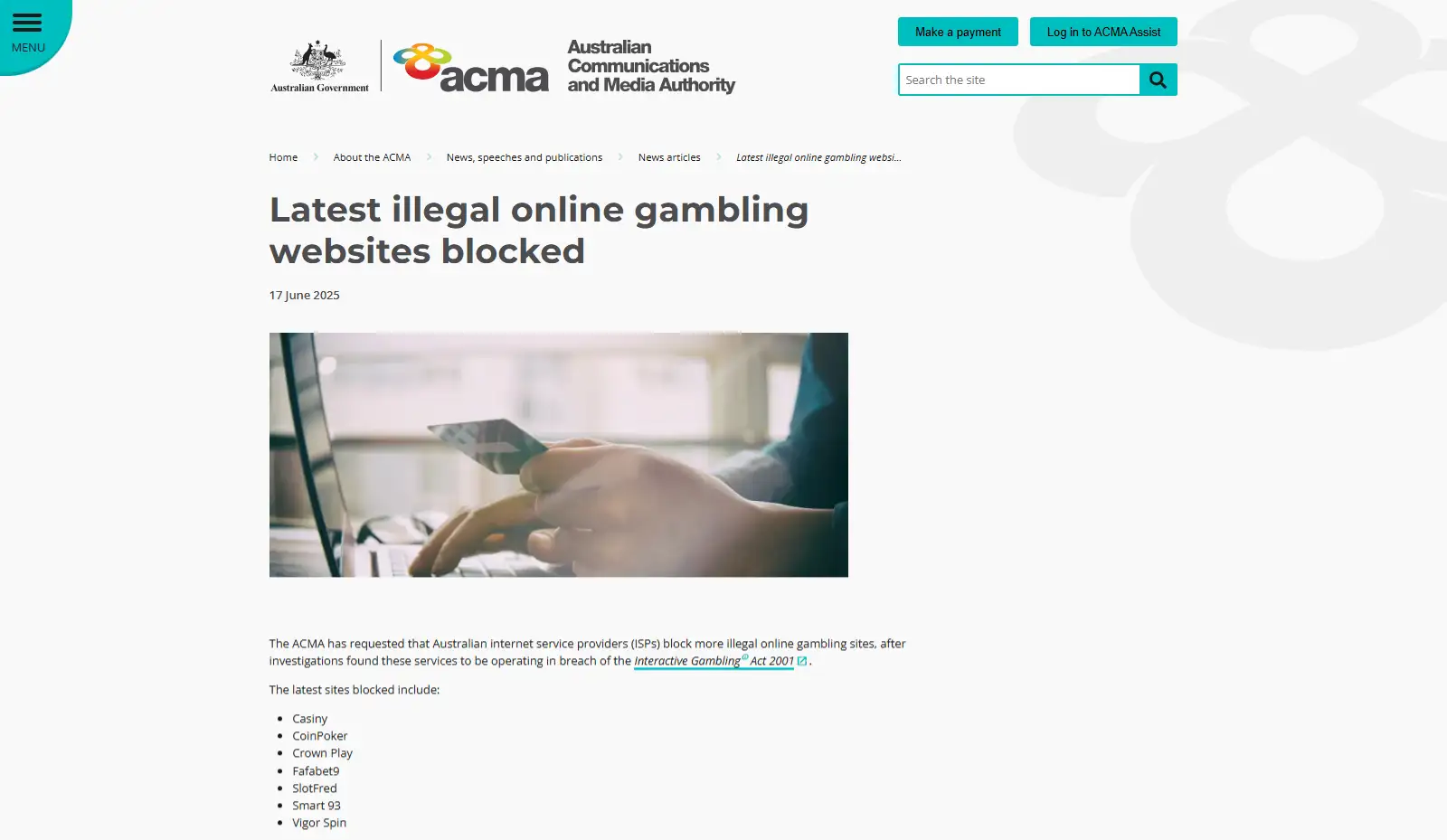
Online casino services cannot legally be supplied to customers in Australia; the Australian licence position explains the restriction.
What the login screen does not settle
Successful sign-in indicates access to an account interface, not that every payment or identity review has been completed. Casiny may request additional verification before a withdrawal, even where an account has been used previously. A remembered device, password manager entry or optional second factor does not replace documentation about the person behind the account.
Mobile access adds another ordinary security issue. A phone can be lost, shared or left unlocked, and browser sessions can remain available after the device screen is closed. The mobile browser overview separates these device-level concerns from the underlying Casiny account rules. The same email/password identity is relevant across desktop and handheld browsers.
One account and payment ownership form the main contractual boundary
Casiny’s terms use a one-account-per-person rule and require accurate personal information. They also set restrictions on payments made with an instrument belonging to somebody else. These conditions connect account registration, later identity checks and the origin of money: an account name that does not match the relevant card, bank account or other payment method can raise an ownership question.
A payment successfully appearing in an account balance is not the same as the operator having accepted every aspect of its ownership. Casiny’s terms allow further checks around the payment route, and withdrawals normally return through the original funding method subject to processor and security constraints. A different requested destination can lead to further verification instead of bypassing the original-method rule.
The risk becomes more complicated with digital assets. A cryptocurrency wallet address describes a transfer destination, while identity checks concern the human who controls it and the account connected to it. A blockchain confirmation records a transaction; it does not prove who owns the gambling account or who should be entitled to a withdrawal. The relationship between wallet access and account identity remains relevant even though the payment rail differs from a card.
Contract breaches can have a financial consequence
Under the operator’s terms, a breach can lead to suspension or closure and, in specified circumstances, voided bets or withheld funds. That is a contractual power asserted by Casiny, not a statement that every disagreement will result in forfeiture. The terms make account accuracy, payment ownership and the applicable game or bonus rules material to how an account dispute may be handled.
For instance, a person may understand a successful transaction as an ordinary deposit while the operator looks separately at whether the payment instrument is in the account holder’s own name. Those are two different questions. Similarly, completing a wagering condition does not by itself settle identity, payment-source and transaction-routing checks. The withdrawal conditions set out the monetary minimum, conditional fee clause and original-method rule in their payment context.
Account closure and exclusion should also be kept distinct. Closure may arise under a contractual term following an alleged breach; self-exclusion concerns a responsible-gambling restriction requested to reduce access. Their possible effect on account access may look similar, but the reasons, timing and handling of remaining balances are not interchangeable.
- Account identity: information supplied about the individual who controls the profile.
- Payment ownership: the relationship between that individual and the instrument used to transfer money.
- Account conduct: adherence to the one-account rule and any applicable playing or bonus conditions.
- Transaction destination: where a withdrawal is directed and why it may need to follow the funding route.
These distinctions explain why a payment dispute can involve account terms even when the dispute first appears to concern only a transaction amount. The parties may be discussing different obligations under the same set of terms.
Identity reviews can involve documents and live checks
Casiny’s identity policy permits requests for proof of identity, proof of address and evidence about the payment method. It also describes the possibility of a selfie, facial verification or a video call. These checks are separate from the email-and-password credentials used for ordinary account access. Casiny’s terms allow them to arise in connection with withdrawal handling and other security concerns.
Identity documents mentioned in its policy include a passport, national identity card or driving licence. For address evidence, the policy refers to utility bills or bank statements from the previous six months. That document window describes a stated policy example, rather than a guarantee that every document inside that window will be accepted in every case. Legibility and consistency of the details remain conceptually different from the age of the document.
| Type of review | Examples from Casiny’s policy | What it is intended to connect |
|---|---|---|
| Personal identity | Passport, national identity card or driving licence | Named account holder and identity information |
| Address | Utility bill or bank statement, with the policy referring to the previous six months | Declared address and supporting records |
| Payment method | Evidence of ownership or payment details | Funding source and person controlling the account |
| Live identity confirmation | Selfie, facial check or video call when requested | Individual presenting evidence and the account identity |
Why a payment and an identity check may be reviewed together
Consider an account whose holder uses a card for deposits and requests funds through a different route. The payment team may need to understand both who owns the original card and why the receiving instrument differs. Providing an identity document answers only one part of that question. An address document answers another. A self-portrait or video review, if requested, may be used to connect the individual presenting those records with the person controlling the account.
These review categories also explain why a successful earlier transaction does not settle every later withdrawal. A processor may have completed the transfer, while the operator still applies a separate account-ownership or verification rule. No fixed processing window should be treated as an entitlement to payment without those checks.
- Identification question: whose name and identity are associated with the account?
- Address question: which residential information is associated with the profile and supporting evidence?
- Funding question: does the account holder control the card, bank relationship or wallet involved?
- Review outcome: is a payment request consistent with the terms governing the account?
Identity records contain sensitive personal information. Requests for such material should be distinguished from ordinary login messages or unrelated communications. A demand for additional documents is not itself evidence of either successful verification or a completed cashout. For the money-related consequences, see the separate explanation of Casiny withdrawal terms.
The core account picture is therefore consistent across the login, controls, terms and KYC policy. Email credentials provide access, responsible-gambling controls set personal boundaries, and ownership checks govern how that account relates to money. Each has a distinct purpose; none substitutes for the others.
Questions about Casiny accounts
How does Casiny account login work?
Casiny describes email-and-password sign-in with password recovery. Its Australian-facing information also describes optional two-factor authentication.
What identification can Casiny request?
Casiny can request a passport or other photo identity document, address evidence, payment-method ownership details and, where required, a selfie or video identity check.
Does Casiny allow more than one account per person?
No. Casiny’s terms apply a one-account-per-person rule and require accurate personal details.
Can account checks affect withdrawal handling?
Yes. Identity, address and payment ownership checks can be part of withdrawal handling, alongside the payment-route conditions in Casiny’s terms.
Which gambling controls does Casiny describe?
Casiny describes deposit, loss and session limits, cooling-off and self-exclusion arrangements; its terms say deposit limits also apply to cryptocurrency deposits.
Identity and payment ownership are central to account access
Casiny’s account structure connects email access, one-person account terms, optional second-factor security and identity checks that can affect payments. A working password is one part of that relationship; matching personal information and ownership of the funding method are another. Deposit, loss and session controls address gambling exposure, while the withdrawal rules address how money moves. Keeping those functions distinct makes the consequences of each account condition easier to understand without treating any control as a payout guarantee.
Read next
- Home
- Withdrawals
- Mobile
- VIP
Written by the editors at Casiny.