
Casiny Notes Australia
Casiny licence and Australian legal position
 Available in US
Casiny operates a casino website with an Australian-facing information route, but Australian online casino law governs whether the service may be offered to customers in the country. ACMA has taken action against the Casiny service, while the operator’s current terms identify a Costa Rican company and an overseas gambling licence. The provider’s legal obligations, the licensing jurisdiction and a player’s payment dispute must be considered as distinct issues.
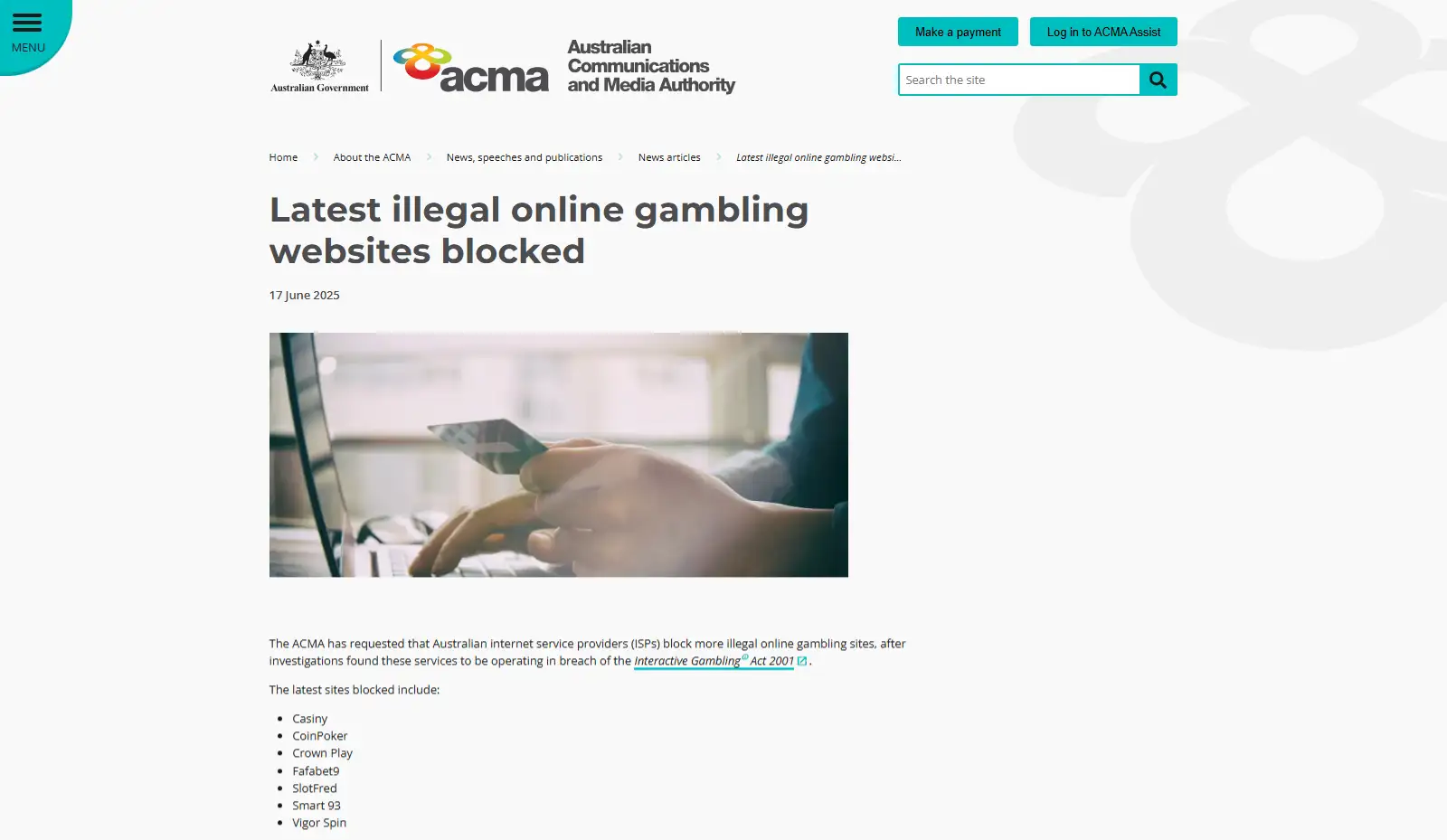
Table of Contents
- Can Casiny legally provide online casino games in Australia?
- Which complaint route fits a Casiny dispute?
- The Casiny operator named in the current terms
- What Casiny’s Tobique licence covers
- How ACMA’s Casiny action developed in 2025
- Questions about Casiny’s Australian licence
- The offshore licence does not authorise Australian casino service
Can Casiny legally provide online casino games in Australia?
No. Under Australia’s Interactive Gambling Act 2001, providers cannot offer prohibited real-money interactive casino services to customers physically in Australia. Online pokies, roulette and comparable casino games fall into that category. This is a rule about supplying particular services to Australian customers, not a claim that every form of online wagering is prohibited. Licensed sports and racing wagering operate under separate rules; they do not authorise an online casino product.
Australia’s communications regulator, the Australian Communications and Media Authority (ACMA), applies the federal restrictions to overseas gambling websites as well as domestic providers. An Australian-language landing page or an AUD balance therefore has no bearing on permission to supply those casino games. Casiny’s Australian-facing marketing describes pokies and card and cryptocurrency deposits; it does not displace the rules governing the underlying service.
The Act’s prohibition on providing a service should also be kept separate from an individual’s possible liability. ACMA’s enforcement finding concerned the provider offering a prohibited interactive gambling service. The same provision is not a blanket criminal offence committed by an Australian merely for playing. That distinction is material when interpreting warnings about an illegal operator, but it offers no assurance about recovering money or obtaining Australian consumer remedies.
What the prohibition changes for a dispute
Where an operator has no lawful basis to provide an online casino service in Australia, a customer cannot assume the dispute mechanisms that accompany locally permitted wagering services are available. Payment processors, account-contract terms and an overseas complaints authority may all play a role, but none turns the prohibited casino offering into an authorised Australian service. ACMA can investigate and act against the provider; it does not act as a general adjudicator deciding the amount of an individual’s casino withdrawal.
The practical risk is financial as well as regulatory. Account access, document requests and pending cashouts are determined by the operator’s systems and terms, while local enforcement may lead internet service providers to block access. The official ACMA explanation of interactive gambling (acma.gov.au/interactivegambling) sets out the categories of prohibited service and their treatment under Australian law.
Which complaint route fits a Casiny dispute?
A complaint about an account balance is different from a report that a prohibited gambling service is being supplied to Australia. Keeping those matters apart helps identify which organisation can address each issue. A transaction dispute needs account and payment records; a regulatory report needs information about the operator and the service offered. Combining both into an undifferentiated complaint can leave the central question unanswered.
- Record the event. For a disputed withdrawal or account decision, preserve the amount, currency, transaction reference, date, correspondence and the contract term the operator invoked. For crypto, the relevant wallet transaction reference is different from a casino account reference.
- Raise the account issue with the operator. Casiny’s terms and support arrangements provide an initial route for account or payment queries. Its support describes live chat and an email contact. The operator is the party able to identify which account rule was applied to a particular balance.
- Use the relevant external complaints channel. The Tobique Gaming Commission complaints information (thetgc.ca/complaints/) addresses complaints involving its licensees. It is an overseas licensing route, not the Australian authority for deciding cashouts.
- Report prohibited service provision separately. ACMA receives reports concerning illegal interactive gambling services and can pursue action against providers. A report to ACMA does not itself order a casino to release a customer’s funds.
Casiny’s payment terms include a usual withdrawal minimum, conditional possible charges and an original-funding-method preference. Those features can explain why a requested amount and the amount returned diverge. The withdrawal limits and fee conditions guide sets out the arithmetic and contractual distinctions. Separate identity and payment-ownership requirements can also affect the operator’s response to a cashout request.
Regulatory action and individual redress are separate
An enforcement warning addresses a breach of the law by a provider. A customer complaint generally concerns performance under the operator’s contract: a rejected request, an identity challenge or a disagreement about a fee. Even when the same brand appears in both settings, one process does not automatically determine the outcome of the other. The Tobique Commission provides information for complaints about its licensees, whereas ACMA’s role centres on enforcing Australia’s interactive-gambling restrictions.
Casiny’s terms allow security checks and measures for suspected breaches, including account suspension and possible withholding of funds. They also require the account and payment methods to belong to the same person. Such clauses make a clear factual record of what happened particularly useful: a disputed fee is not the same as a rejected identity check, and neither is identical to an ACMA investigation.
The Casiny operator named in the current terms
Casiny’s current terms name Neptune Projects S.R.L., a Costa Rican company with registration number 3-102-900308, as the owner and operator. The company’s stated registered address is in Granadilla, Curridabat, San José, Costa Rica. These are the terms governing the identity of the operator in the current brand documentation; they should not be replaced with an older provider name taken from an enforcement record.
Dama N.V. appears in a different role. ACMA’s formal warning of 20 May 2025 addressed Dama N.V. as the provider associated with Casiny at www.casiny.com during the regulator’s investigation. That historical reference establishes who received the warning, not who is named in Casiny’s current terms. The known events do not establish the date or contractual mechanics of any transition between the two entities, so the current and historical roles remain distinct.
| Entity | Role | Why the distinction matters |
|---|---|---|
| Neptune Projects S.R.L. | Operator named in current Casiny terms | Primary contractual identity for the site’s current account and payment terms |
| Dama N.V. | Provider addressed in ACMA’s May 2025 warning | Identifies the recipient of the historical Australian enforcement action |
For account matters, this distinction can determine whose terms are being invoked and which company a complaint names. For enforcement history, it prevents a newer operator identity from being incorrectly inserted into a document addressed to another entity. Corporate names in a brand’s terms, a gambling licence register and a regulator’s enforcement decision can perform different functions even when they concern the same casino service.
Tax treatment does not confer gambling permission
Australian tax treatment is a separate question from whether a casino service may be supplied in Australia. Occasional recreational gambling winnings are generally treated differently from business-like gambling income, and subsequent dealings with cryptocurrency can raise additional tax considerations. Neither treatment grants an operator permission under the Interactive Gambling Act. An Australian tax professional can consider the nature of particular winnings, crypto transactions and individual circumstances.
What Casiny’s Tobique licence covers
Casiny identifies Tobique Gaming Commission, associated with the Tobique/Neqotkuk First Nation in New Brunswick, Canada, as its gambling licensing authority. The brand displays licence number 0000020. The commission’s public licence-holder directory (thetgc.ca/license-holders/) lists Neptune Projects S.R.L. among B2C remote-gambling licensees. A B2C entry relates to the operator’s remote gambling authorisation within that licensing system.
The operator-level listing and coverage of a particular website domain are separate questions. Casino Guru associates casiny.com with Casiny’s licence number, while the publicly readable holder directory presents the company entry without a complete per-domain breakdown in the same listing. A company entry should not be treated as an Australian approval, nor should a third-party domain association be mistaken for a direct Australian regulator decision.
Tobique’s authorisation sits within its own jurisdiction. It does not override restrictions imposed by other countries on accepting customers, advertising products or offering prohibited games. In Australia the relevant service category is prohibited for suppliers, so even a valid overseas remote-gambling licence does not make Casiny an authorised local online casino.
Licence jurisdiction and consumer recourse
When an account dispute involves an operator licensed abroad, the customer may need to consult the complaints process provided by that licensing authority. Tobique publishes a licensee-complaints pathway, which is relevant to the operator’s obligations under its own framework. It is not a substitute for Australian consumer-protection rights associated with locally permitted products, and a complaint outcome is not a guaranteed cash payment.
The distinction matters because a licence number can answer who supervises an operator while saying little by itself about eligibility in a different country or the terms that apply to an individual transaction. A regulator in one jurisdiction generally cannot be assumed to offer the same dispute tools, court access or payment remedies as another. Describing the issuing body and the Australian legal status separately is more precise than treating all gambling licences as interchangeable.
How ACMA’s Casiny action developed in 2025
ACMA investigated Casiny’s service provision to Australian customers under the federal Interactive Gambling Act. The regulator identified the service at www.casiny.com and found that prohibited casino services had been provided to Australian customers. The formal warning was addressed to Dama N.V., reflecting the provider under investigation at the time, not the operator named in the current website terms.
| Date | Event | Meaning |
|---|---|---|
| 26 February 2025 | ACMA investigation commenced | Examined the provision of prohibited interactive gambling services associated with Casiny |
| 20 May 2025 | Formal warning to Dama N.V. | ACMA concluded that provision of the Casiny service breached section 15(2A) of the Act |
| 17 June 2025 | ACMA announcement of ISP blocking | Casiny was named among services targeted for blocking by Australian internet service providers |
The warning is a regulatory finding about what occurred under the Act, not an editorial conclusion based on a casino’s reputation score. The blocking step targets the availability of services found to be illegal under Australian rules. It should not be interpreted as evidence that a particular customer has won or lost a contractual payment dispute.
ACMA’s June 2025 blocking announcement on acma.gov.au expressly includes Casiny. ACMA’s blocked-websites material also records casiny.com and related site addresses. The address list is enforcement history, not a directory of alternative ways to reach an account; using alternate domains or other circumvention steps does not alter the legal position.
The regulator’s action also explains why an Australia-specific marketing page should not be mistaken for a domestic authorisation. That marketing describes games and transaction methods; the formal warning addresses the legal ability to supply those games to the country. These are different properties of one service. The chronology provides a direct answer to the licence question without treating generic star ratings or offshore credentials as Australian legal permission.
Questions about Casiny’s Australian licence
The legal position, corporate terms and routes for raising a complaint answer different questions about the same service.
Is Casiny an authorised online casino for Australian customers?
No. Australia prohibits providers from offering real-money online casino services to customers in Australia. Casiny was also named in ACMA enforcement and blocking actions.
Which authority issues the gambling licence Casiny displays?
The Tobique Gaming Commission in New Brunswick, Canada. Casiny displays licence number 0000020. That licence is not an Australian online casino authorisation.
Which company operates Casiny under its current terms?
Neptune Projects S.R.L., a Costa Rican company. Dama N.V. was the provider addressed in ACMA’s May 2025 enforcement warning.
Can ACMA settle a disputed Casiny withdrawal?
ACMA enforces Australian interactive-gambling restrictions. An individual withdrawal issue begins with the operator; Tobique also publishes a complaints route concerning its licensees.
The offshore licence does not authorise Australian casino service
Casiny has a Tobique licensing connection and a current operator named in its terms, but neither changes Australia’s prohibition on providers supplying real-money online casino services to Australian customers. The ACMA warning and subsequent blocking action concern the Casiny service itself. Those official events are distinct from an individual customer’s contractual issue, which may still require payment records, the operator’s response and a complaint route outside Australian payout regulation.
Anyone assessing this brand should distinguish legal permission to offer a service from the existence of a gambling licence elsewhere and from a website’s advertised catalogue. These are different questions with different answers; a prominent casino interface or an Australian currency option does not merge them into one.
Read next
- Casiny overview
- Card and cryptocurrency payment methods
- Game formats and studios
Created by the ”Casiny” editorial team.